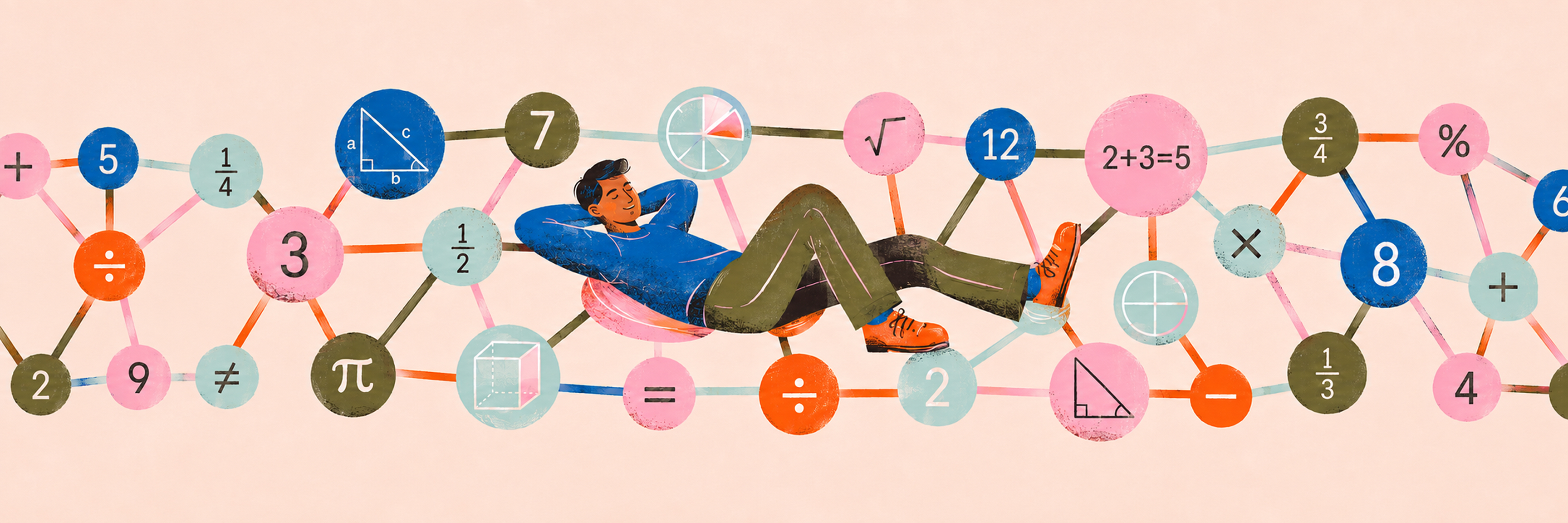
You don’t have to be a maths specialist: Connecting Maths Concepts is beside you
You start September feeling confident that this year will be different. This year, you’ll make the difference. And then, somewhere between place value and number bonds, you spot it – that familiar look on a child’s face. The one that says I’m trying… but I’m drowning. By October half term, you have that moment when you’re standing in front of your class thinking, there has to be a better way to teach this.
I’ve been a primary teacher for many years, and in that time I’ve worn more hats than I can count – class teacher, SEN lead, maths lead. I’ve stood in front of classes where 80% of pupils were flying and 20% were sinking fast. And, like every maths lead I know, I tried everything to pull them up.
I tried everything. Number lines. Beads on strings. Tens and ones. Counters. Cakes cut into fractions. I spent hours rearranging the order of operations, rethinking representations, rewriting explanations, swapping strategies with colleagues, and searching for the magic combination that would finally make the learning stick.
And still, those children – the ones who needed me most – made tiny steps of progress and carried huge amounts of frustration.
Until I met Connecting Maths Concepts.
It went against everything I had been taught in my career. No manipulatives. Multiple concepts taught at the same time. Answers given, not discovered. Stage, not age. A script.
It shouldn’t have worked.
But it did.
And not just for the bottom 20%. For everyone.
Placement that actually helps you teach
CMC placement doesn’t ask you to sift through data or guess where a child belongs. It tells you – clearly, quickly, and accurately. Children are grouped by what they can access, not by the year group printed on their exercise book. And from that firm foundation, they move.
Beside every uncertain start, a clear next step.
 Scripted lessons that remove the guesswork
I know the word scripted can make teachers wince. I winced too. But the CMC script didn’t take away my teaching – it made it consistent. It gave me and my colleagues a shared language, a shared pace, and a shared approach to concepts that had always been hard to teach. From ECTs to experienced teachers, we gained the knowledge and confidence to teach maths well.
For the first time, everyone knew how to teach the concept, not just what the concept was.
Teachers have told me their own maths skills have improved because of the programme. They feel better informed about how a concept can be broken down into small, meaningful steps that genuinely support pupils to secure the learning and make links to other ideas. Instead of guessing how to simplify a tricky concept, they now have a clear, research‑driven route through it.
Staff can focus on delivery rather than spending hours creating lessons they hope will work. The script provides carefully constructed explanations, small steps, and a pace that supports every learner. And it doesn’t erase anyone’s personality – my “jazz hands” teaching style stayed firmly intact.
Mastery built in, not bolted on
CMC doesn’t leave you guessing whether a child has “got it”. The programme tells you. Built‑in, ongoing assessment shows you exactly what pupils have secured and what they still need to master.
And here’s the real game‑changer:
Intervention becomes quick, precise, and effective.
Instead of vague targets and six‑week cycles of crossed fingers, any staff member can pick up the exact part of the script a child needs to revisit. Conversations between teachers become razor‑focused on the specific gaps, not general impressions.
And the pupils? Their love of maths becomes universal.
They want to complete independent work because they can do it. They get it. They feel successful. They’re proud to show off their skills and knowledge – not just to their teacher, but to each other. That sense of “I can do this” spreads through the classroom like wildfire.
The bigger truth: structure frees great teaching
Teachers sometimes worry that structured programmes will deskill them. In my experience, it’s the opposite.
When the technical decisions are made for you – what to teach next, how to sequence it, how to assess it – your professional energy is freed up for the human bits. The quiet encouragement. The moment a child who has always hated maths suddenly smiles because they’re keeping up. The confidence that grows when success becomes normal, not rare.
CMC didn’t just help the bottom 20%. It helped everyone. It gave me an approach that teaches all children well – not just the ones who were already flying. And it didn’t take away my personality or my creativity. It simply gave me a structure that made those strengths land.
 Heading back to school?
Somewhere this September, a child will sit in a maths lesson and feel that familiar panic rising. They’ll stare at the page, hoping no one notices. They’ll also be hoping – quietly – that someone does.
They don’t need a teacher who has every answer. They need a teacher who turns up, sits beside them, and is willing to try. The rest – the placement, the script, the sequencing, the mastery checks – can be carried for you by a programme built to do exactly that.
By Sarah Green, Direct Instruction Trainer & Coach | Emotional Logic Coach | SEND Education Advisor (Local Authority)